Jonas Gülstorff (An Author Spotlight Interview - February 2026)
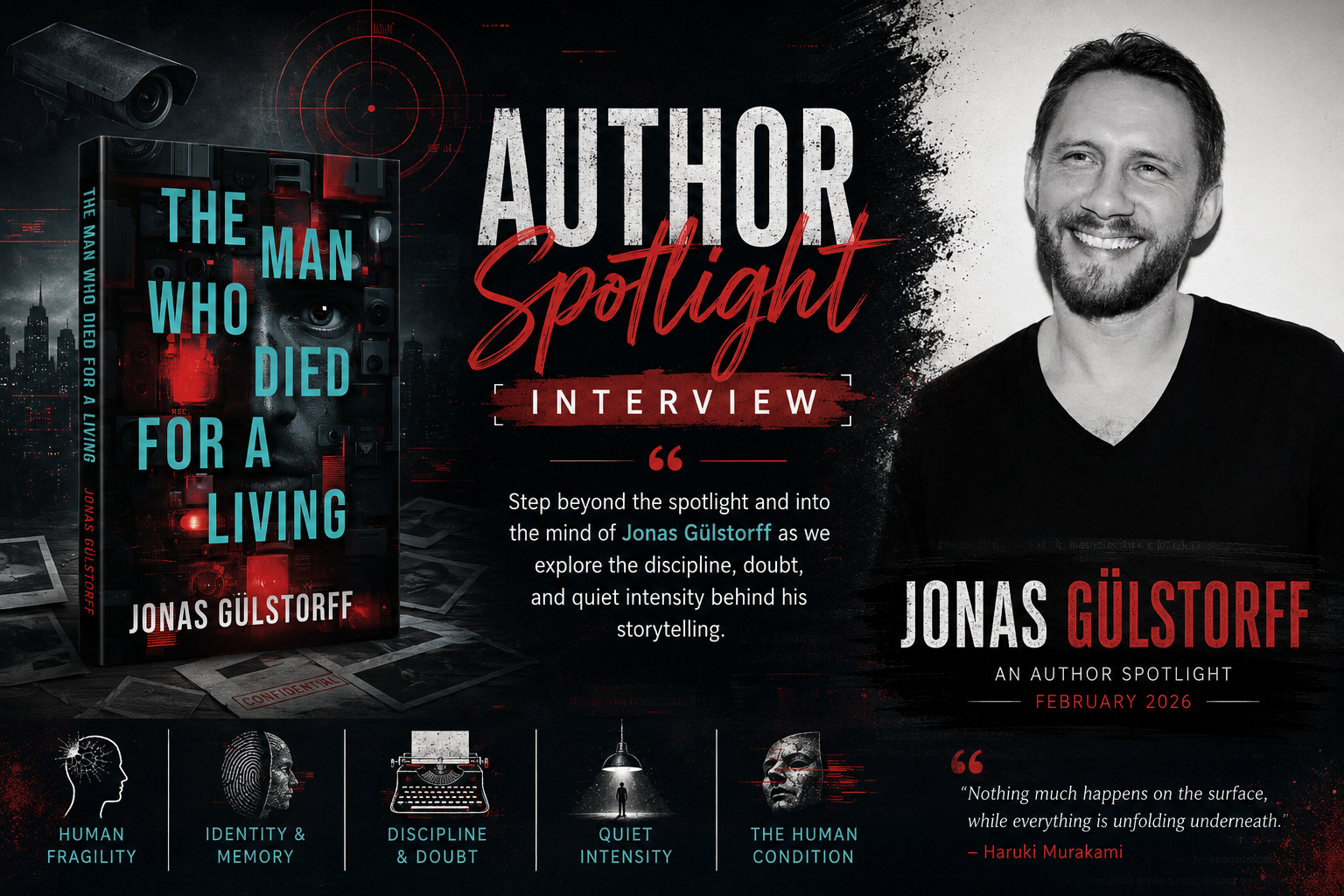
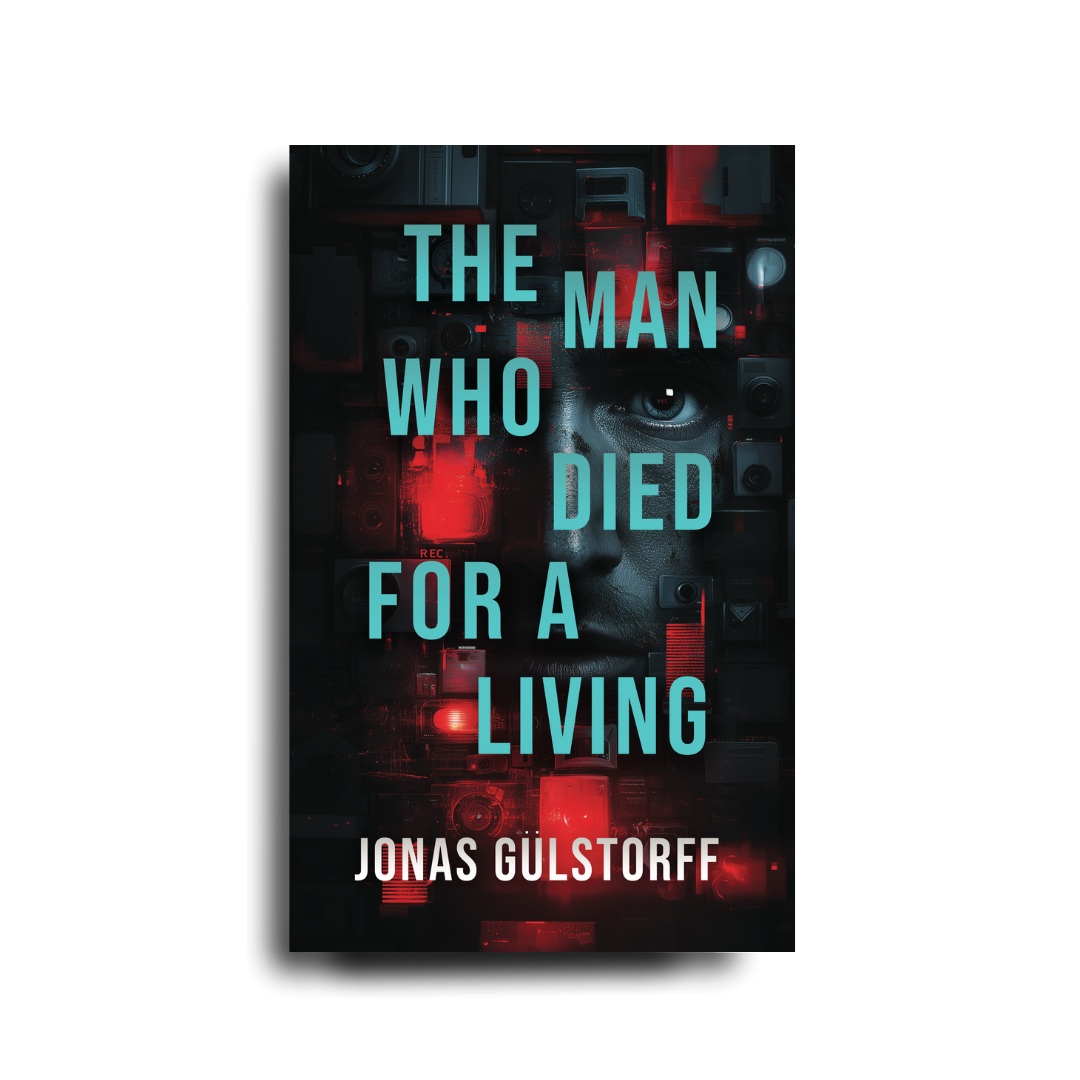
As reality fractures and guilt lingers long after the final cut, Jonas Gülstorff invites readers into the unsettling psychological depths of The Man Who Died For A Living. A tense, introspective thriller that blurs the line between performance and identity, the novel explores surveillance, memory, and the fragile masks we wear to survive. With a background spanning radio, television, songwriting, and poetry, Gülstorff brings a layered, almost cinematic precision to his prose, where what simmers beneath the surface often matters more than what explodes into view.
Deeply influenced by the quiet intensity of Haruki Murakami and the enduring power of character-driven storytelling, Gülstorff writes with a fascination for the human condition: its contradictions, its empathy, and its capacity for both beauty and harm. His work does not shout for attention; it unsettles, lingers, and asks difficult questions long after the final page.
In this exclusive Author Spotlight, Jonas reflects on his evolution from reader to creator, the discipline that fuels his daily craft, and why he believes the only way past doubt is to keep writing, even when the words resist you. Thoughtful, deliberate, and emotionally aware, his storytelling reminds us that sometimes the most dangerous truths are the ones unfolding quietly beneath the surface.
Join us as we step beyond the spotlight and into the mind of Jonas Gülstorff, exploring the discipline, doubt, and quiet intensity that shape his storytelling and uncover how he transforms human fragility into fiction that lingers long after the final page.
1. Can you tell us a bit about yourself and your journey as a writer?
I started out writing scripts for radio and television. From there I moved into songwriting, which eventually led me to poetry. I found that ideas and fragments that didn’t quite belong in songs could exist on their own on the page. Over time, those pieces grew into a poetry collection, which became my first published book. So writing has always been a constant in my life, the form has simply changed over time.
2. What inspired you to start writing, and how did you discover your passion for storytelling?
Ever since childhood, books have been my gateway to other worlds. That early spark of discovery is what still drives my passion for reading and, ultimately, my desire to contribute to the craft. Transitioning from a reader to a storyteller has allowed me to go from visiting worlds to creating them. Being able to imagine, shape, and share these narratives is a privilege, and I honestly couldn't ask for a better job.
3. Could you share some insights into your creative process? Do you have any rituals or habits that help you write?
For me, writing is a craft, it’s work, and the only way through is to keep showing up and moving it forward every day. I also like to keep several creative projects going at once. That way, when I sit down to work, I still have a sense of choice. Some days you don’t want to return to a particular piece, and that’s fine, you can turn to something else and still remain productive. It keeps the work moving
4. What themes or messages do you often explore in your writing, and why are they important to you?
I try to explore different themes in each book, but it always comes back to what it means to be human. People both fascinate and frighten me, to be honest. That tension is probably the central theme in everything I write. I read and write as a way of trying to understand the human condition. Our contradictions, our motivations, and the complexity of how we relate to one another.
5. Are there any particular authors or books that have influenced your writing style or storytelling approach?
The Count of Monte Cristo. Even after all this time, it still feels incredibly alive and compelling. I also love Shantaram by Gregory David Roberts. My favorite writer, though, is Haruki Murakami. I deeply admire his ability to create a sense that nothing much is happening on the surface, while everything is unfolding underneath. That quiet intensity and subtle movement on the page is an extraordinary skill, and one I find deeply inspiring.
6. Do you have any advice for aspiring writers who are just starting their journey?
For me, the most valuable approach is to enjoy the work and write what genuinely interests you. That authenticity is usually what connects with readers in the end. Alongside that, I believe in discipline, setting daily goals and sticking to them. It’s a simple habit, but it’s the most reliable way to move a story forward and eventually bring it to completion.
7. How do you balance writing with other aspects of your life, such as work, family, and personal interests?
Ideas tend to come to me in everyday moments. I’ll jot down notes on the train or the bus, or even in the supermarket on the back of a grocery list. I’m often thinking about characters and plots whenever I have a spare moment, especially when I’m out walking. Often the inspiration for the next story comes from being out in the world rather than staying home to write.
8. How do you stay motivated and overcome writer's block when faced with challenges in your writing process?
I don’t really believe in writer’s block, even though I experience it all the time. Honestly, I just keep writing and accept that sometimes what I produce isn’t very good. That can go on for hours, days, or even months, but I write through it. Pushing forward, even when the work feels difficult or uninspired, is the only way I know to get past those periods. For me, continuing to write, even imperfectly, is always better than doing nothing.
9. How do you manage your time and set goals to ensure consistent progress in your writing projects?
When I settle on an idea, I try not to overthink it in the beginning. The first stage is about momentum, I write and keep pushing until the first draft is finished. Only after that do I step back and begin refining and polishing the work.
10. How do you handle moments of doubt or uncertainty in your writing process, and what strategies do you use to persevere through challenges?
When I’m in doubt, I rely on good editors and on conversations with other writers. Writing can be a very solitary process, so having trusted people who can challenge the work, offer perspective, and give honest feedback is essential.
11. What role do emotions and empathy play in your writing, and how do you strive to evoke emotional responses from your readers?
The characters I love most always carry strong emotional awareness and sensitivity. I look for that quality in people as well. When I meet strangers, I often notice how their empathy comes across, and those observations frequently find their way into my writing. It’s something I draw on constantly when shaping new characters.
12. Can you share any insights into the importance of a strong opening hook or first chapter in capturing readers' attention and setting the tone for the rest of the book?
I think the opening line should offer the reader a sense of promise, something that signals the tone of the book and hints at the story’s themes. That isn’t always possible in a single sentence, but it should happen within the first paragraph. The reader needs to feel what kind of world they’re entering.
13. Can you discuss any experiences of writer's block or creative burnout, and how do you rejuvenate your creativity during those times?
When I can’t write, I read. Sometimes what I pick up feels so good that it’s almost paralysing, it makes me think I’ll never be able to write anything worthwhile again. When that happens, I switch books. Sooner or later, I come across something that sparks a different reaction. I start thinking, I could approach this differently, or even do it better. That competitive little voice is often exactly what I need. Then it’s back to the desk. It works every time.
14. Are there any upcoming projects or future plans that you're excited to share with your readers?
I’m currently working on a new series, the first trilogy I’ve ever written. It follows a group of outlaws who take matters into their own hands and try to correct what they see as having gone wrong in the world. There’s no shortage of real-life material to draw from at the moment, which makes the themes feel both timely and urgent. That said, this is a project I’ve been developing for quite some time, and I’m very much looking forward to sharing it with readers.
Books By Jonas Gülstorff