Kyle Scarlett (An Author Spotlight Interview - September 2025)
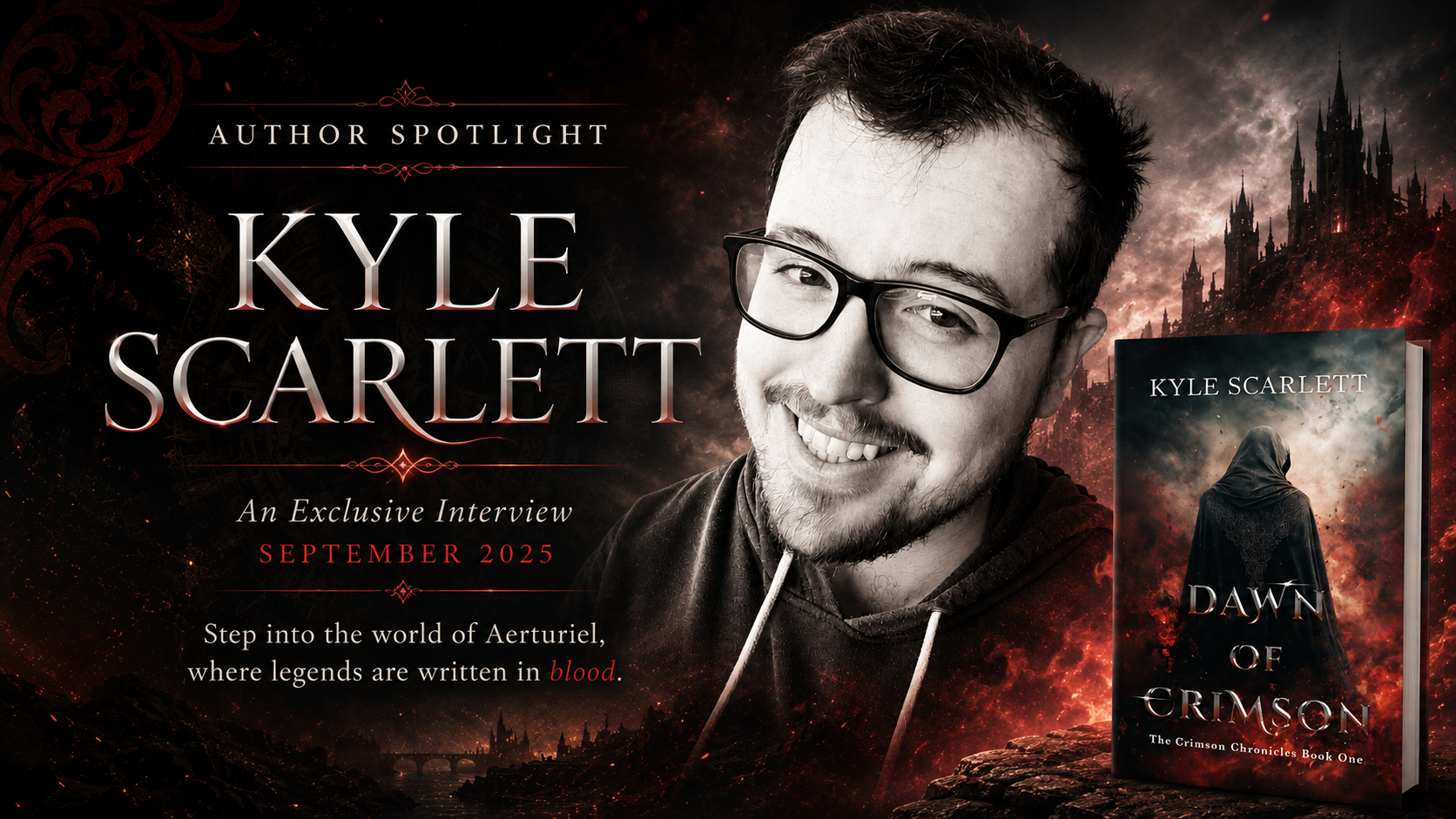
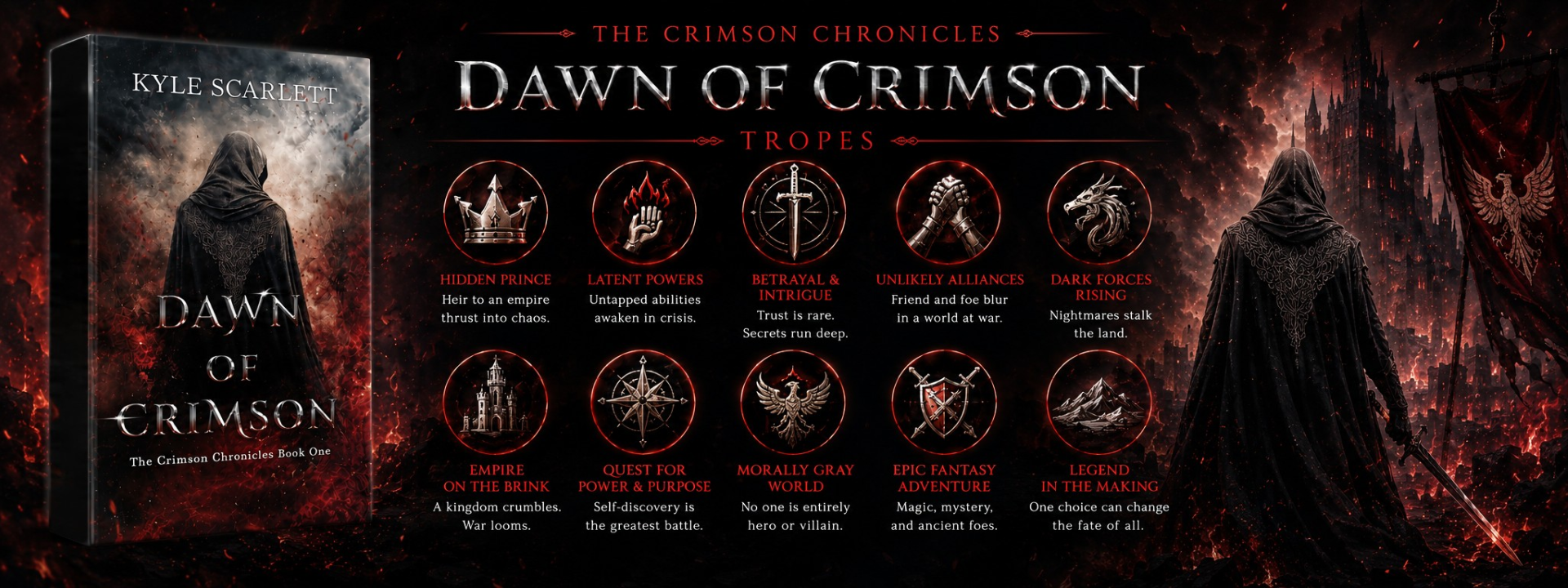
As autumn approaches, a bold new voice in epic fantasy is ready to pull readers into a world as dangerous as it is breathtaking. Dawn of Crimson by Kyle Scarlett marks the beginning of a sweeping saga set in the realm of Aerturiel, where power, corruption, and haunting histories collide. With its intricate worldbuilding, emotional depth, and battles that cut as deeply within the heart as they do across the battlefield, this debut promises a tale both intimate and vast—where every choice carries the weight of generations.
At the center of this story stands Vanimire, a reluctant hero navigating a city divided between wealth and ruin, light and shadow. As ancient threats stir and political corruption seeps through the streets, Vanimire must confront not only beasts and tyrants but the inner battles of expectation, doubt, and the crushing weight of legacy. Steeped in history yet driven by character, Dawn of Crimson blurs the line between survival and sacrifice, and asks: what do we become when the world demands more than we can give?
In this exclusive interview, Kyle Scarlett shares how childhood storytelling, the imaginative realms of World of Warcraft, and years spent as a Dungeon Master shaped his passion for fantasy. From tackling themes of toxic masculinity and imposter syndrome to exploring the corruptibility of power, Scarlett brings both raw honesty and sweeping imagination to his work. With influences ranging from Tolkien to Sanderson, and a historian’s eye for detail, he crafts a debut that is as thoughtful as it is thrilling.
Join us as we uncover the inspirations, challenges, and creative fire behind Kyle Scarlett’s unforgettable debut and step into the mind forging a new legend, one tale at a time.
1. Can you tell us a bit about yourself and your journey as a writer?
Hey there! I’m Kyle Scarlett, born and raised just outside of Toronto over here in Ontario. Like many, it feels remarkably difficult to pin down exactly where my journey as a writer began. I have vague memories of writing and performing a story for my fourth grade English class, though from my recollection, I think it would be more apt to describe it as a ‘script’. There was little by way of descriptions and scenery; flowery prose was traded for simply naming who was delivering each line, as the characters spoke back and forth. I want to say it was focused on them fighting in large mechs, but I’m not sure where nine-year-old Kyle would have picked that up from!
My journey really took off when I first discovered World of Warcraft, where I quickly fell in love with both the world and its story. I wanted to feel a part of it and take that which I loved and make it feel personalized. I quickly found others that shared a similar passion, which allowed it to flourish. That natural love of writing my character in a world that fascinated me led to writing short stories in both high school and university, and then to the intoxicating realm of writing campaigns for Dungeons and Dragons! That was really the Pandora’s Box moment. All that I adored about writing and fantasy was found there, and it naturally led to the longform writing that produced Dawn of Crimson!
2. What inspired you to start writing, and how did you discover your passion for storytelling?
Like many, it started as a way to take the stories that were constantly rotating in my head and breathe life into them. I was fortunate to be constantly surrounded by others that not only encouraged the pastime but offered a source of both inspiration and encouragement. I wanted to entertain them just as their stories entertained me. That was the inspiration, and as I continue to find myself surrounded by such creative company, the inspiration continues!
Though I discovered a love for writing stories through that fourth-grade class and playing World of Warcraft, I think the passion really flourished when I first discovered Dungeons and Dragons. It quickly became an obsession, and as soon as I realized it was possible to create not only a story, but a world through which my friends could engage with, the fascination was very quick to manifest. Whether I was good at it or not, only my friends were able to say, but the passion was quick to manifest. Suddenly I had the power to take those short stories that had always fascinated me and weave them through a world that I had created. My friends, who gathered at the table with excitement and eagerness that constantly blew me away, helped to make these stories and worlds even richer, and it was through the art of trying to entertain them that the passion continued to flourish!
3. Could you share some insights into your creative process? Do you have any rituals or habits that help you write?
My creative process, likely due to the many years spent penning campaigns for Dungeons and Dragons, starts with the world itself. I spend far, far too much time fleshing out the world, and populating it with cities, towns, religions, and tiny tidbits that no one will likely appreciate, but make my brain buzz. If there was ever a point in my life where I get to make use of my master’s in history, it would certainly be here. I find it much easier to outline the story when the world itself feels full of life to me. It becomes a canvas, through which outlining Vanimire’s adventure feels easier. More often than not, it’s in this stage where unexpected ideas present themselves, and the story seems to take on a life of its own!
When it comes to habits and rituals, I fear that mine are remarkably boring. I find that a steady routine helps to ensure the creativity presents itself. I try to write a few thousand words a day, allowing myself to write more on the days when the words seem to flow freely, and do less when the writer’s block inevitably hits! Then I sit down, with far, far too much caffeine, and throw up some sort of ambient music to help focus—huge shout outs to the ‘Animal Crossing’ melodies—and that’s all there is to it!
4. What themes or messages do you often explore in your writing, and why are they important to you?
For me, I try to explore both micro and macro themes. For the former, it’s the notions of toxic masculinity, the role that expectation plays on a mind that’s riddled with uncertainty, and the struggle of trying to overcome the endless beast that is imposter syndrome. How my characters give voice to these internal themes, and the ways that they try to deal with them service to make them feel more real.
When it comes to macro themes, or those that are woven through the world itself, I find that once more I get to make use of the many-a-countless-hours spent studying history. The corruptibility of power, the inter-generational pain that’s oft woven into memories, and the problems that arise from wealth-hungry centralized powers. In many ways, the world of Aerturiel is one that has been created from historical inspiration. For good and evil. It’s important to me that the world itself is complex and presents opportunities where it too can be seen as a villain, even if it proves to be one that the characters aren’t fully able to conquer just yet. As the fantastic Dungeon Master, and endless source of inspiration Brennan Lee Mulligan once said, capitalism is the real enemy, and I find any character’s journey can’t fully be complete without grappling with these macro-themes that constantly plague them!
5. Are there any particular authors or books that have influenced your writing style or storytelling approach?
I would be remiss if I didn’t begin by touching upon the influence of Tolkien. Lord of the Rings was my first foray into Fantasy, and I still fondly remember having to get a permission slip to check out Fellowship of the Ring from the school library. Tolkien showed me a door that I never knew existed, and Sanderson so kindly kicked it wide open. When it comes to the beauty and depth of one’s world, I can think of no others who do it best.
From there, however, there are so many names that spring to mind that I almost worry that I’ll inevitably forget one and then look back upon this answer in shame. My shelves are filled with Christie Golden’s World of Warcraft books, and I remember reading her author’s note at the back of one and being inspired by the journey she’d taken—one that I find myself mirroring, albeit to a much more humbled degree! Andrezj Sapkowski, John Gwynne, Dmitry Glukhovsky… the list goes on and on. Oh! I have to give credit to Brian Jacques, if only because Redwall still holds a near and dear place to my heart.
Lastly, though perhaps not as much an inspiration as the others, I have to mention Gregory of Tours. Is it cheating because he’s a sixth-century historian? Perhaps. However, if I can get even one more person to read ‘The History of the Franks’, I will have done my degree justice. A gripping historical account of early France, and even with the expected added flair, is there any tale more gripping than real life? (Yes, almost all of them, but I digress). If you think Game of Thrones is a wild journey, I promise you that the historical accounts recorded by Gregory are just as gripping.
6. Do you have any advice for aspiring writers who are just starting their journey?
I relied heavily on the advice given to me by my friends, and the inspiration that they continue to provide. Many, many years ago, my friend Zara gave me a piece of advice that still comes to mind: ‘Read, Read, Read’. It’s one thing to read novels in the genres you like, but by branching out, and exploring those that you are largely unfamiliar with, you stand only to further develop yourself as a writer. Though fantasy has always been my bread-and-butter, by reading Sci-Fi, or Post-Apocalyptic, or even romance, you pick up on small tidbits that can only ever help to improve your own skills. Want to learn how to describe a feast with such wonderful prose it leaves the reader’s mouth watering? Check out Redwall! The subtle horrors of a world ravaged by nuclear fallout? Metro 2033! As writers, I feel there’s never a moment when we’ve learned it all, and with the fun that comes from reading new novels and fleshing out your own writing skills, why stop?
7. How do you balance writing with other aspects of your life, such as work, family, and personal interests?
Poorly, normally.
Just a joke! Depending on what stage in the writing process I’m on, the ability to balance changes greatly. Though I tend to think about my story, whether it be writing, thoughts, ideas, or plans often, I typically sit down to write in a single, uninterrupted block. For me, I like doing this as soon as I am able, whether that be first thing in the morning, or as soon as the afternoon allows it. This way, when I achieve the daily goals I’ve set aside for writing, I can feel productive whilst also having the time to devote to other parts of life, whether that be family, personal interests, friends, etc.
8. How do you stay motivated and overcome writer's block when faced with challenges in your writing process?
Like many things in life, writing is a marathon, rather than a race. It’s inevitable that there will be days when the words flow more easily, just as there will be days when it feels impossible to come up with even a handful. On the days when writing is fun, I allow myself to write far more than my daily goal. In turn, when writing is more difficult, I try to remind myself that it’s okay to write less. This give-and-take keeps me on pace, whilst also allowing the mind to relax more when its needed.
It's likely not super helpful that my advice is just ‘if it’s feeling like a rough day, it’s okay to take a break’, but so often we are our own worst enemy, and it only becomes worse when there’s a deadline looming on the horizon. Despite it all, it’s important to take breaks and put the writing aside and let the mind focus and relax on something else.
9. How do you manage your time and set goals to ensure consistent progress in your writing projects?
I find that setting nice, rounded daily goals helps with providing the dopamine that comes from seeing the number slowly tick up. Typically, my goal is anywhere from 2000-4000, though I tend to write more on days where writing is easier, and less when the mental fatigue is setting in! I find that giving yourself the leniency needed on those days when it’s more difficult helps, given that we are always our worst critic. So long as you find ways to treat yourself when you surpass your goals, and keep in mind that it’s okay to fall short of them sometimes, it all evens out in the end!
10. How do you handle moments of doubt or uncertainty in your writing process, and what strategies do you use to persevere through challenges?
This is the eternal struggle, isn’t it? That feeling that comes from stepping back and looking at your work and seeing it as a product of all that is wrong with it, rather than cherishing the triumphs. It’s difficult! There’s a wonderful quote by John Green about giving himself permission to suck, and that is what I try to focus on when those moments of self-doubt arise. With any first draft, I think the most important part is getting the ideas on paper. In subsequent stages we can comb through and tidy up the parts we don’t like, but there will always be those shadows of doubt lurking in your mind. When all else fails, having others in your life that know your writing, and can step in to help reassure you that uncertainty and doubt are all in your mind helps immensely. I know I couldn’t have managed it without the assistance of friends and family!
11. What role do emotions and empathy play in your writing, and how do you strive to evoke emotional responses from your readers?
This is what it’s all about. If reading doesn’t evoke some sort of emotion, then what is the purpose for it? Just like in life, the most memorable stories are the ones that evoke some sort of emotion, whether that be the jubilant heights of happiness and excitement, or the aching lows of sorrow and misery. We as writers oft allow the emotions of that which we’re creating to seep into us, which can create a sort of self-feeding loop, though there’s certainly much to be said about ensuring the bleed over isn’t too detrimental!
For my own work, I find that if the characters are grounded in their surroundings, and feel like real individuals, their ability to serve as conduits for the emotions of the reader becomes easier. Emotions are more easily pulled if the reader feels like the characters they’re reading about are embodied with struggles and thoughts that either they have experienced or know someone who has. We often write from a position of experience, and that is certainly true when it comes to my own works!
12. Can you share any insights into the importance of a strong opening hook or first chapter in capturing readers' attention and setting the tone for the rest of the book?
When anyone speaks of the importance of a strong opening hook for a book, I think everyone has a myriad of examples spring to mind. Whether it be the whimsical introduction to the Shire, or the terrifying thrill that’s experienced when it comes to burning books. A strong opening hook is what pulls the readers in immediately and is often one of the sole sources of judgement for those that may have picked up your book on a whim in a bookstore. We’re constantly surrounded by hundreds, if not thousands of potential worlds to explore, and there’s no better way to stand out than by providing a strong opening line that makes the reader want to learn more.
Once you’ve hooked the reader, having a strong opening hook for each subsequent chapter is like a little gift, a reward for giving you their attention, and a tool by which you can pull them further, and further into the story you wish to tell.
13. Can you discuss any experiences of writer's block or creative burnout, and how do you rejuvenate your creativity during those times?
With any creative, no matter the size and scope, it’s inevitable that there will be moments of creative burnout, or when you feel like you’ve hit a wall. We all have those moments where it feels like we’ve suddenly never written a word before, or drawing a single line feels strange. In conquering these, I think it most important of all that you give yourself the space to unwind and relax, distancing yourself from the creative endeavor, whatever it may be. When we hold ourselves to high standards it can ensure that we’re following a routine, but when we fall short it can lend itself to being overly self-critical. Above all else, it’s important to allow yourself the room to breathe, whether that be by making up the missed writing on another day, or just simply stepping away from it all and letting the mind fully recharge.
For me personally, I’ve come to learn that there’s no way for my brain to recharge and break through that creative block without fully stepping away from it and doing something else. When it comes to writing, I’ll try to step away and watch a movie, or step outside, or do whatever else may spring to mind—usually with a cup of coffee in hand!
14. Are there any upcoming projects or future plans that you're excited to share with your readers?
Though there is SO much I wish I could talk about, I’m sure I would earn a well-deserved slap on the wrist if I were to speak too freely! Rest assured, Vanimire’s adventures in Aerturiel are far from over, and with every new face that stumbles onto the pages, my mind continues to fill with all manner of exciting possibilities! The plans I am most excited for are a luxury saved for me alone, I fear, and that is seeing just how the world of Aerturiel, and the characters that breathe life into it, are received! I’m very excited to see thoughts, speculations, and reactions as this tale slowly unfurls from my mind, unto the pages that will soon be in front of you!
Books By Kyle Scarlett