Morrigan Ellis (An Author Spotlight Interview - October 2025)
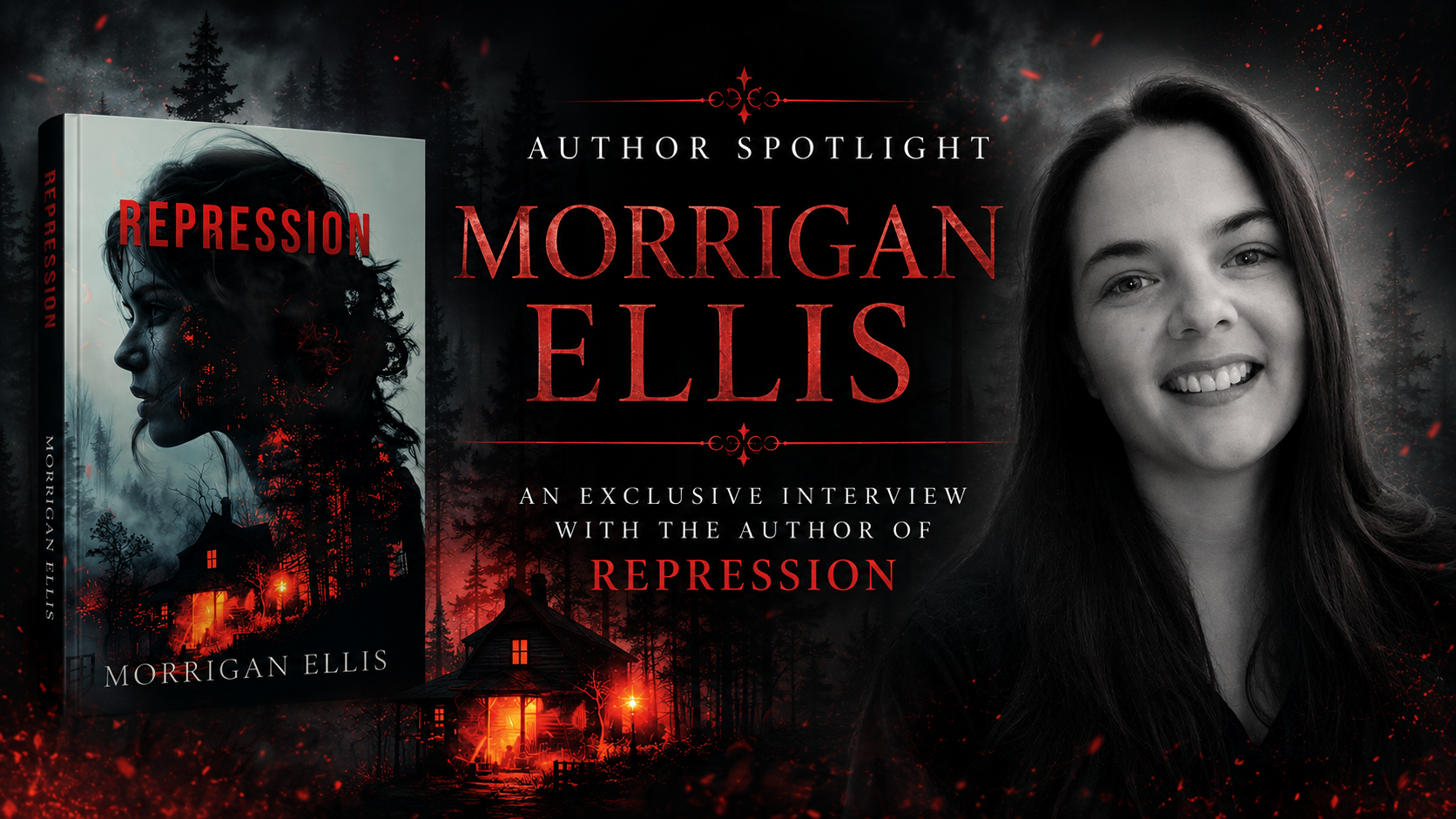
As autumn’s chill settles in and the days grow darker, debut horror author Morrigan Ellis invites readers to face what lurks beneath the surface with Repression—a haunting psychological tale where grief, memory, and the supernatural intertwine. Set in a small town steeped in secrets, Repression blurs the line between what’s real and what’s repressed, exploring how the ghosts of our past can be just as terrifying as those that haunt the night.
Ellis’s passion for horror began in childhood, but it wasn’t until the isolation of the pandemic that her first novel took shape—a deeply emotional, character-driven story about loss, fear, and the fragile boundaries of the human mind. Drawing inspiration from genre icons like Ania Ahlborn, Grady Hendrix, and Stephen Graham Jones, Ellis crafts horror that cuts close to the bone: intimate, unsettling, and achingly human.
In this exclusive Author Spotlight, Morrigan opens up about her creative journey—from her early love of storytelling and late-night writing rituals to overcoming imposter syndrome and finding empowerment through the act of scaring readers. With raw honesty and a deep understanding of the emotions that drive horror, Morrigan Ellis proves that sometimes, the scariest monsters are the ones we create ourselves.
Join us as we explore the imagination, fear, and creative spark behind Repression and discover how Morrigan Ellis turns emotion and unease into powerful, unforgettable horror.
1. Can you tell us a bit about yourself and your journey as a writer?
My writing journey began like I think it does for most writers: as a reader. I devoured horror novels from a very young age. From there, I fell in love with storytelling in all mediums. Books, movies, plays; you name it. I get totally immersed (and sometimes a smidge obsessed). When I really engage with a story, I always think, “I want to make people feel that!”
2. What inspired you to start writing, and how did you discover your passion for storytelling?
My passion for horror writing came when I started to find amazing female writers in the horror field. Growing up, I think a part of me felt like it wasn’t an option for me to write scary stories, because the ones that I encountered were predominantly male. It really lit a fire under me once I realized that I could be the one scaring the pants off people.
During Covid, I took the opportunity to really dive into my first novel. It felt like the right time for a big project, something that I could concentrate on when the stress of the news cycle got to be too much. From there, the first draft of Repression was born. Looking back, the impact of writing at that time was clear, because the characters are all isolated in different ways.
3. Could you share some insights into your creative process? Do you have any rituals or habits that help you write?
I always start my writing sessions on paper. There’s something about the tactile sensation that really helps get me going. I am a night owl writer, so the issue I often have is that any stresses of the day follow me into the evening. I use the start of my time to freewrite for about 20-30 minutes, just pen to paper, no stopping. Getting out any frustrations from your workday, a fight you had with a friend, a broken water heater, whatever it is, makes a huge difference. I find that usually after 10-15 minutes, my focus naturally shifts and I find myself puzzling out a plothole.
I’m also someone who doesn’t do quiet. I have to have something in the background. Sometimes it’s a movie, but most often it’s music. As the story starts to flow, I find myself picking specific music for what I’m working on. For Repression, I landed on the Yellowjackets soundtrack and Radiohead most of the time.
4. What themes or messages do you often explore in your writing, and why are they important to you?
I am the first to admit that I’ve never been great at writing to a theme. I am a notorious pantser, so I often start out by writing a scene that I can picture clearly and working the story around it. The themes that reveal themselves often surprise me as I start to flesh them out, but there are definitely some that I find come up more often.
One of those broader themes is the place of your hometown in your identity. Did a character leave and come back? Did they make a choice to stay and how has that impacted their life now? Have they ever wanted to live anywhere else? Is home a place, or people, or memory? A hometown is often so tied to your earliest memories. When a story involves a hometown community, I always picture my own. It is such a rich area that can be explored in so many ways, both nostalgic and heartbreaking.
5. Are there any particular authors or books that have influenced your writing style or storytelling approach?
I think every book that comes into our lives influences us, consciously or not. It’s always so interesting thinking about the books that have impacted me, because they have found me in so many stages of my life.
Like many horror-loving kids reading novels in the 90s, I made the leap from Goosebumps and Scary Stories to Tell in the Dark to Fear Street to Stephen King in fairly rapid succession. The leap to very adult horror was when I learned the important distinction between scary and disturbing. The Invisible Man by H. G. Wells and Ray Bradbury’s stories weren’t far behind, and they completely blew me away.
In more recent years, Ania Ahlborn has been a steadfast favourite. As soon as I see anything by her, it’s an instant read. Grady Hendrix, Zoje Stage, Alma Katsu, Rachel Harrison, Nick Cutter, Stephen Graham Jones, Silvia Moreno-Garcia…they have all solidified for me in their own ways that horror is not going anywhere, and is the perfect genre for colouring outside the lines. There are way too many authors to name, and I can’t wait to discover even more.
6. Do you have any advice for aspiring writers who are just starting their journey?
It’s really easy to get caught up in making things perfect. As a person who struggles with procrastination, I’m prone to falling into endless pits of agonizing over the right word. I have to remind myself when that happens that I’m probably avoiding getting to the next part. It’s easy to get overwhelmed, but becoming aware of those moments and pushing through. Once that first draft is done, it’s a game changer for your confidence. No matter what happens next, you just wrote a book!
Don’t be afraid to write down whatever you’re thinking. Just get yourself moving and you can take out the pieces that don’t work later.
7. How do you balance writing with other aspects of your life, such as work, family, and personal interests?
Learning to prioritize writing took time. Once a week, I write down the things I have to do. I start with appointments, plans with family and friends and any other commitments I have coming up. From there, I plan out what my ideal days/times for writing are. If I have a weekend with nothing planned, I’ll set a boundary for myself that those days are for writing only. On the other hand, if I have a three day family reunion, I accept that I likely won’t get much writing done. The trick is making sure you commit time in a way that makes you feel like you are not only setting realistic goals, but achieving them.
Writing every day in some form is ideal, but not always realistic. The best way to find balance is to treat writing like a friend and schedule some dedicated time, then commit yourself to not ditching. Once I started doing that, I was able to dedicate quality of time to writing, instead of worrying about the quantity.
8. How do you stay motivated and overcome writer's block when faced with challenges in your writing process?
Focusing too hard on a specific problem is the easiest way to get stuck. When I dig into the editing process, I start by making notes about what I’m trying to fix, including related events that happen before and after in the story. When working on plot points, I was really surprised to find that sometimes the problem wasn’t in the part I was working on, but could actually be fixed in the lead up or aftermath.
The most important thing I have learned is to walk away before you get to the point of wanting to slam your head on your desk. Move on to the next part. Your brain will still be working on the problem, and often days later you’ll be in the middle of family dinner and need to run to write down the solution that came to you while you were passing the salad. Celebrating the wins when this happens is a great way to stay motivated; every one moves you toward your goals, even if it’s small.
9. How do you manage your time and set goals to ensure consistent progress in your writing projects?
I am a list maker by nature, so I embraced that habit to keep myself on track. I set weekly goals, and add an estimated time to accomplish each task. I try to keep a variety of timeframes, so sometimes I split up larger tasks to make them manageable. For instance, working through a plot hole might be something I dedicate several evenings to. However, smaller tasks that are more technical in nature might only take about an hour.
I try to have some smaller tasks set aside for after a workday I know is going to be busy, or if I know I also have plans and will be tired. Being able to cross an item off my list will help me avoid feeling overwhelmed by unrealistic goals. The nights I get really into it and get way more done than planned are so satisfying, and allow me some flexibility later in the week if I need a break. Weekly planning is a little more work at the outset, but has really helped me with setting goals that are achievable and realistic.
10. How do you handle moments of doubt or uncertainty in your writing process, and what strategies do you use to persevere through challenges?
Oof. I really feel this question. Imposter syndrome is strong in me. I’ve heard a lot of people who aren’t published say they feel like they aren’t a “real” writer. As a soon-to-be-published author, that hasn’t gone away completely. I have to remind myself that someone really wanted to read my story and hear what I have to say, otherwise they wouldn’t be publishing it.
Criticism is hard, but someone having a criticism of your story is not synonymous with someone thinking you’re a terrible writer. Remembering this is easier said than done, and I think it will be something that I will always grapple with as a people pleaser. Recognizing that doubt will be a part of my process is the best way that I’ve been able to manage it.
11. What role do emotions and empathy play in your writing, and how do you strive to evoke emotional responses from your readers?
Emotions have always played a big part in my writing, particularly in Repression. I’ve always been a fairly insular person when it comes to my own emotions, so I find stories about our secret lives below the surface fascinating.
Emotions so often dictate stories, even if it’s not something that we actively identify. In a story of revenge, for instance, the answer to “Why did he do it?” is not “Because his son was murdered.” The answer is actually that the emotions that he felt when his son was murdered drove him there. It wasn’t about the act itself, but how the act made him feel. Horror novels are so often tied to our primal emotional cores and that’s something that I hope to continue to explore.
Empathy is about understanding how someone feels, and I think that is a big part of why horror has the ability to make people uncomfortable. It shines a light into the dark corners of our minds and asks “What would you do?” It’s the same reason a motiveless killer is so terrifying; we always seek to understand motives, and not understanding is not the same as having nothing to understand. That void is terrifying.
12. Can you share any insights into the importance of a strong opening hook or first chapter in capturing readers' attention and setting the tone for the rest of the book?
The opening scene is absolutely vital. I focus on tone and atmosphere here, telling the reader what kind of book they’re in for but leaving me free to surprise them along the way. I think of it like showing them a beautifully carved box. The box is locked. Making them want to figure out where the key is so they can open it is the hardest part.
13. Can you discuss any experiences of writer's block or creative burnout, and how do you rejuvenate your creativity during those times?
The longer I stare at the blank page, the more impossible it feels to fill it. I love writing, and it is a privilege to be published. However, it’s easy to fall into this strange guilt spiral where you feel awful when you don’t love every minute of it. At those times, I try to take a moment to collect myself and figure out what’s going on. Am I genuinely blocked, or am I just procrastinating? The hard answer is that sometimes you need to walk away and take a break.
Sometimes I try writing something else. I’ll try my hand at a romance or fantasy story, something outside of my usual comfort zone. It’s been a great way to stretch my creative muscles in a different way. If that’s feeling too daunting, I’ll turn my focus to reading. I might pick something I normally wouldn’t read, or the top of my endless TBR pile, or maybe an old favourite for comfort. In the meantime, I’ll get someone to read some of my work. Getting some feedback after a break can really help tackle your work with a fresh perspective. Talking to a friend about your frustration can also help. Writing is a very isolated activity, so having the chance to voice my doubts and frustration works wonders.
14. Are there any upcoming projects or future plans that you're excited to share with your readers?
I am currently working on a second horror novel about the aftermath of the dissolution of a coven that I hope will appeal to anyone who was fortunate enough to have The Craft as a part of their formative years.
Books By Morrigan Ellis