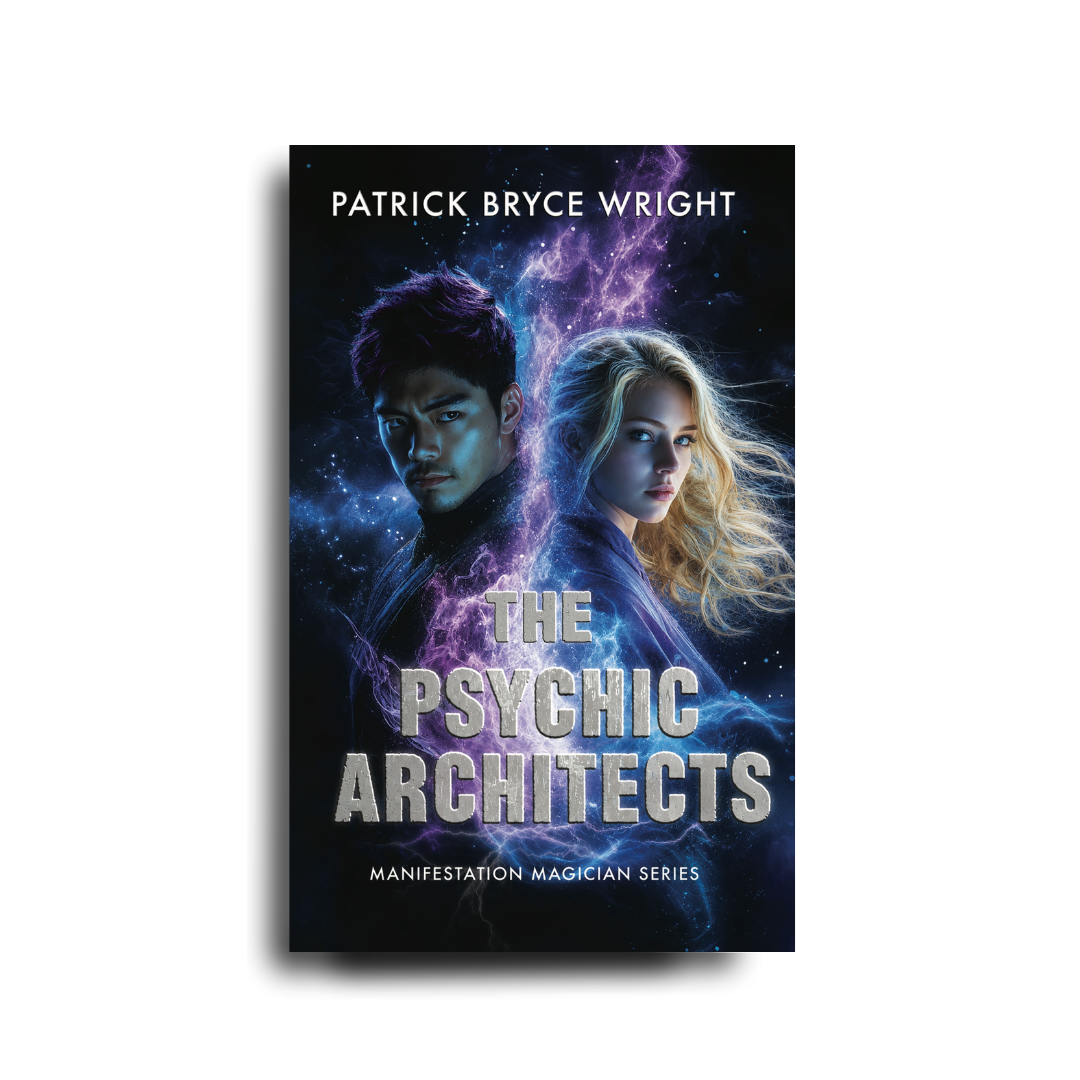
Patrick Bryce Wright (An Author Spotlight Interview - July 2025)
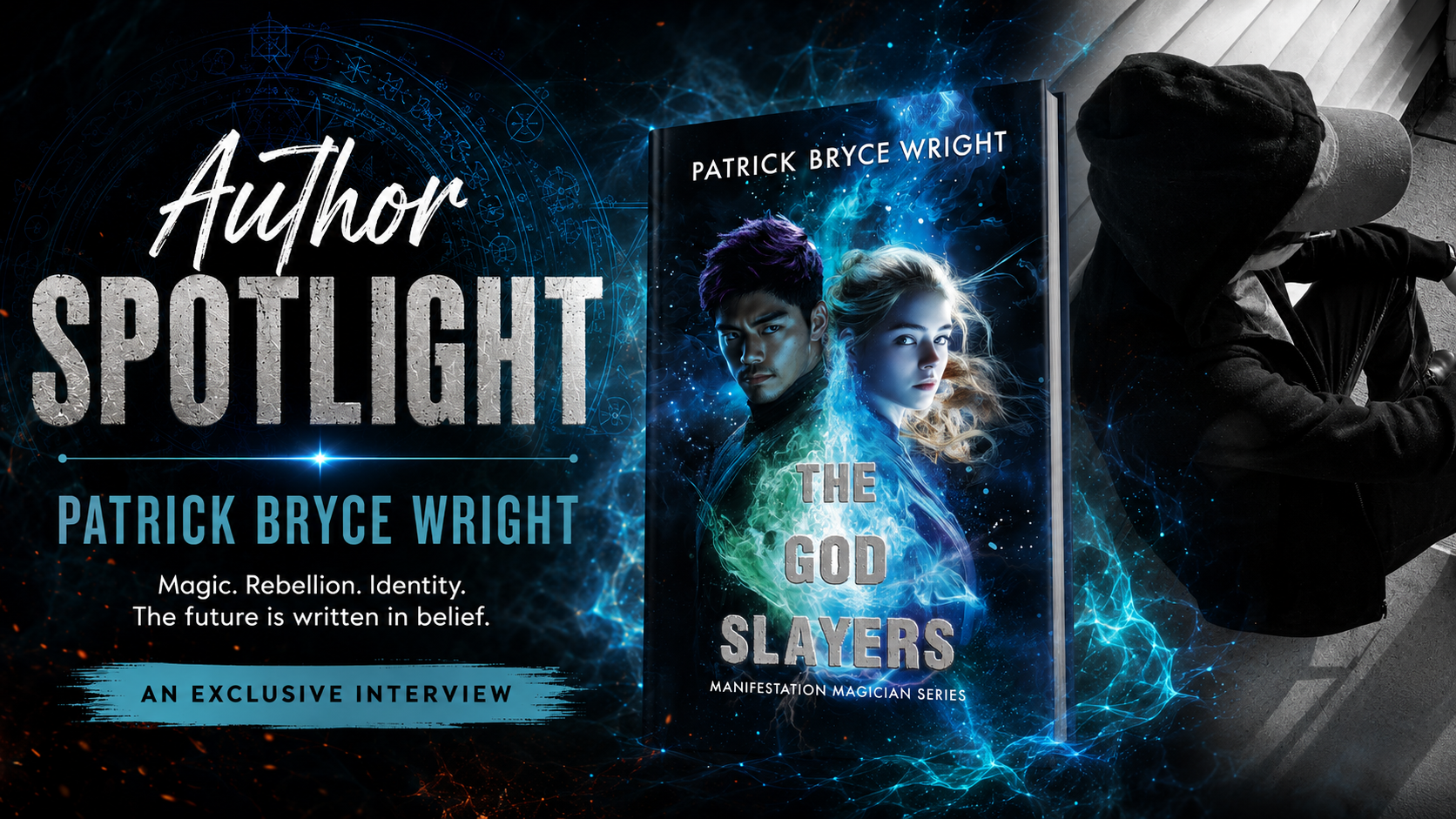
As the summer heats up, so does the arrival of one of the most fiercely original and emotionally charged fantasy debuts of the year. Releasing July 29, The God Slayers by Patrick Bryce Wright delivers a powerful collision of science fiction, religion, identity, and magic in the launch of the Manifestation Magician series. Set in a fractured future where gods fall, belief shapes reality, and magic is both liberation and danger, this is a story that doesn’t just cast spells—it casts truths.
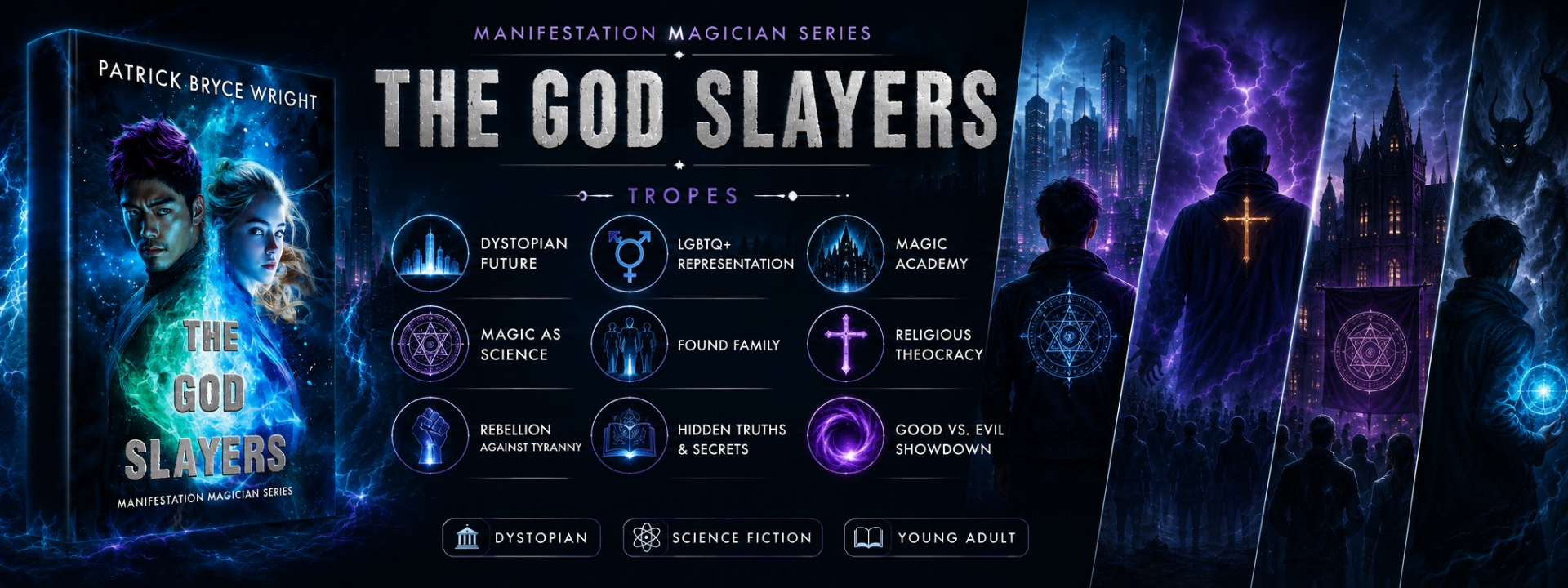
In the dystopian year 2095, transman Kenzie Okuda escapes the rigid theocracy of the United Republic of America, hoping to find freedom in a society where magic is science and difference is embraced. But when a malevolent force is unleashed on his university campus and religious extremism threatens to consume the last sanctuary of magical study, Kenzie and a group of students must unravel a conspiracy that blends ancient gods, future tech, and personal trauma. At the center of it all is the question: What do we manifest when we refuse to surrender who we are?
In this exclusive interview, Patrick Bryce Wright opens up about the deeply personal roots of The God Slayers, the complexities of world-building a future shaped by fundamentalism and rebellion, and how his own lived experiences with queerness, neurodivergence, and dissociative identity disorder shaped the novel’s multifaceted characters. With thoughtful reflections on power, faith, and the battle for internal and external freedom, Wright’s voice brings an urgent and necessary presence to the genre.
Bold, unflinching, and deeply human, The God Slayers is more than a fantasy epic—it’s a story of survival, chosen family, and radical self-acceptance in the face of tyranny.
Join us as we explore the inspirations, challenges, and creative vision behind The God Slayers, offering a powerful glimpse into the mind shaping the Manifestation Magician series and its bold reimagining of magic, identity, and resistance in a fractured future.
1. The God Slayers is a bold and evocative title. What does it mean within the context of the story, and how did you land on it as the opener to your series?
It’s a winding kind of story, really. My original idea was completely different, and the gods I used weren’t from mythology but rather ones I created. I started with the concept of Top Hat. Therefore, when I completely rewrote my first draft, I wasn’t sure if I’d be able to keep the title. However, religion became a major part of the novel, as well as the difference between religion and nationalism.
My characters get stuck with the label “God Slayers” because of another character’s hate, and they have to decide whether they will be ashamed of that or wear it with pride. Therefore, I’d have to say one meaning of the title is tied to college hazing.
2. This is the first book in the Manifestation Magician Series. How did you approach building a world where magic and gods collide, and what sets this world apart from other fantasy landscapes?
I knew from the first draft that I wanted to use the trope of magic as science, and I decided in the second draft to use the mageocracy trope. So at the foundation, I had to decide which kinds of magic would be tied to science. For example, the physics of gravity and acceleration make them easy choices for gravity and speed spells. Then I had to decide to what extent everyone could use the spells and to what extent specific noble clans would specialize in them.
However, I also wanted things used in the actual magical systems on Earth, such as the ones in Wicca. Wicca doesn’t believe in Satan, so Logan and Zoe don’t, either. Wiccans can choose to follow Pagan deities like Thor, so I researched the Norse pantheon. The next thing I knew, I had gods colliding with magic.
As for how my series is set apart, I would say it’s the Christian elements. I was born into a fundamentalist denomination and held to conservative standards, which is incredibly hard on someone who is LGBTQIA+. I didn’t set out to merge my futuristic magic science world with Christianity, but I had imagined the U.S. suffered a second Civil War and split along religious lines. In reality, such a war wouldn’t create the clean split of the North and South, but I needed to simplify the backstory. I even split the state of Kentucky in half because Kentucky was split during the Civil War, with part of its citizens fighting for the Union and part for the Confederacy. Once I combined Civil War history and fundamentalist Christianity with magic science, my brain spat out the world you see in TGS.
3. What was the first image, character, or idea that sparked the beginning of this book — the moment that made you realize, “This is the story I need to tell”? Your story explores power, rebellion, and belief. What deeper themes did you find yourself drawn to as the narrative unfolded?
The first image I had was Kenzie fighting a mysterious being on a college campus on the first day of classes. The idea behind that was, Great, I’m a college freshman on a new campus in a new city, and here I am having to fight something I don’t understand. I suppose it was an allegory for starting college: a new world with new challenges, but with a sci-fi spin. It’s like, “Isn’t college hard enough without this happening?” I had a rough start to college, both as a freshman and during my first year as a graduate student, and I expressed part of that symbolically.
I think a lot of people who attend college experience it as a time to explore rebellion and belief. Are they going to stick with their family’s religion and traditions or forge their own path? For me, this happened more in graduate school than undergrad, and as a professor, I see it happening all around me in both undergrad and grad students.
The theme of power unfolded because of the way I’ve seen religion abused. I’ve met a few preachers, Sunday School teachers, and others who used church and religion to terrify people into obedience or whatever other behavior they wanted. It was always a nasty situation, and it left scars on me. As a result, religious themes show up in most of my novels.
The tension between the Christian and Pagan characters in the novel is a reflection of my own personal experiences. (I always capitalize Pagan because it is an umbrella term for several faith systems in the same way Christianity is an umbrella term for several denominations.) To understand this part of the novel is to first understand that I have dissociative identity disorder (DID), which used to be called multiple personality disorder. This means I am a collection of several internal individuals, and some of those inner people have different religions. For example, there is at least one Catholic, one Wiccan, and one atheist. When I was in college, these inner people fought each other about what to believe, although as an adult, we collectively have found a place of balance and peace. In fact, Moriah represents one part of me and Logan another. I’ve wondered if people will think I’m mocking Moriah, but the truth is I (by which I mean Patrick, specifically) used to be a lot like her. I have a great deal of empathy for her. Logan and Zoe are Pagan. Makari is Catholic. Moriah is Protestant. Shinrou is a lifelong atheist. Kenzie and Rachel are ex-Christian atheists. In this sense, my characters represent me, both in the sense of my internal multiplicity and also in the sense of showing different phases I’ve gone through. I enjoyed bringing part of that interplay to the page.
4. Let’s talk characters. Who challenged you the most to write authentically, and who ended up surprising you in the best way?
Kenzie both was and wasn’t the biggest challenge. Kenzie is a transman, and so am I—a transman with nonbinary leanings and he/they pronouns. I was able to write authentically about the first steps in coming out and establishing a trans identity. However, Kenzie is also half Japanese American and half White. This was where the challenge began. My life partner and developmental editor, Keith Miller, is part Jewish, like Moriah and Rachel, so I relied on some of his experiences, challenges, and feelings. However, Keith and I both had to do research about Japanese American experiences. Keith took Japanese language classes in high school, so he’s always been interested in Japanese culture and life. I took karate and likewise became deeply interested in Japanese culture. We used that as our starting point and built from there.
As for the character who surprised me most, that was probably Rachel. She’s struggling with a depth of feeling evil that I didn’t expect. I knew she would struggle with some self-hate, but her sense of having an inner darkness is stunning. She also clearly sees how bigotry affects her. She turned out to be an incredibly intelligent and discerning character.
To a lesser extent, I was surprised by how much fun Zoe Wang is. I had the least idea about who she would be when I began, and she proved to be a delight.
5. Fantasy often involves building intricate systems of magic. How does manifestation work in your world, and what inspired its design?
As I mentioned above, part of me is Wiccan. The concept of manifestation is a real debate, both in Pagan communities and in psychology. How do you make a spell manifest? If you’re Christian, how do you make a prayer manifest? Or, if you use psychology, how do you make your goals manifest? It’s a huge discussion, but I can give a small example. You can’t, for instance, cast a spell or pray a prayer for a new job and then do nothing but play video games. You have to put together a resume, look for job ads, and apply. Psychology talks about this in terms of a growth mindset and a self-fulfilling prophecy, which can be used in a positive way and not just a negative one. In short, psychologists might say you believe you can get the job, and your positive attitude plays a role in your success.
I grabbed the concept of manifestation and added it to two other discussions: character abuse and AI rights. The abuse of characters is a hot topic in some fandoms, and in some countries, people are discussing the abuse of AI, including, for example, men calling a female-voiced AI words like “bitch” and “slut” when the AI can’t perform a function. So I ended up in interesting territory: If a character could be given a physical body—if a character could be manifested thanks to a creator’s goals or desires—then what would happen? How should we feel about that? And what if some of those characters had religious implications?
6. Without spoiling anything, can you share a favorite scene or moment from The God Slayers, one that gave you chills while writing it? You blend action, emotion, and myth with ease. How do you strike a balance between epic spectacle and personal stakes?
I’ve got a couple scenes that stand out to me. One of them has to do with Moriah right before the climax. It’s an incredibly dangerous situation, and Moriah surprised and impressed me with her aplomb.
Balancing epic spectacle and personal stakes is manageable when you value your characters as people. Several authors have spoken about how real their characters become and how it can derail their plots. I’m in that camp. I once had a character derail my plot during Act I of my novel, and I had to scramble to rearrange my plans to accommodate that. As long as I focus on my characters and their development as people with real problems, real crises, and real dreams, then I can keep my novel from turning into nothing but special effects on paper.
7. As book one of a series, how does The God Slayers lay the groundwork for what's to come, and can readers expect even bigger shifts in future instalments?
This book introduces key concepts: telepathy (or mind magic) and materialization or manifestation of non-living bodies. Both of those concepts will be part of book two.
I’m careful about the issue of bigger shifts. I don’t want to set up a series in which the big boss you have to defeat in each novel gets bigger and bigger. If I do that, then the final battlefield might have to be the entire universe, if you get what I mean. However, it’s also true that this book’s ending has big implications the characters will have to deal with, both ethically and politically. The first wave of those implications hits in book two.
8. For readers about to step into this world for the first time, what would you want them to know, or feel, as they turn the first page?
I would want them to know I’m going to discuss some serious topics, like religion and politics, but I want them to have fun on my playground, too. The best sci-fi does this: It talks about the present moment by using a future stage. The original Star Trek series (TOS) always struck me hard when it did that. I appreciate the commentary on the 1960s it has to offer. At the same time, people love Star Trek in all its many forms because of the worlds it creates. The same is true for Star Wars. So, like my character Zoe, I want people to have fun.
Also, my goal is to signal from page one that this is not only a story about characters who are LGBTQIA+, but also it’s a story for readers who identify as LGBTQIA+ or have close ties to someone in the community. This is not a book where the existence of transgender people is a debate. No one has to “prove” they’re trans. The conflicts that drive the plot don’t have to do with challenging anyone’s identity. For example, Moriah doesn’t have to stop being Christian. Zoe doesn’t have to stop being Pagan. Trying to force someone to change their identity solves nothing. Plenty of people across the ages have chosen to go to the stake, be hanged, or die by the sword rather than give up their identity. Humans have strong feelings about their personal internal sanctity.
Books By Patrick Bryce Wright