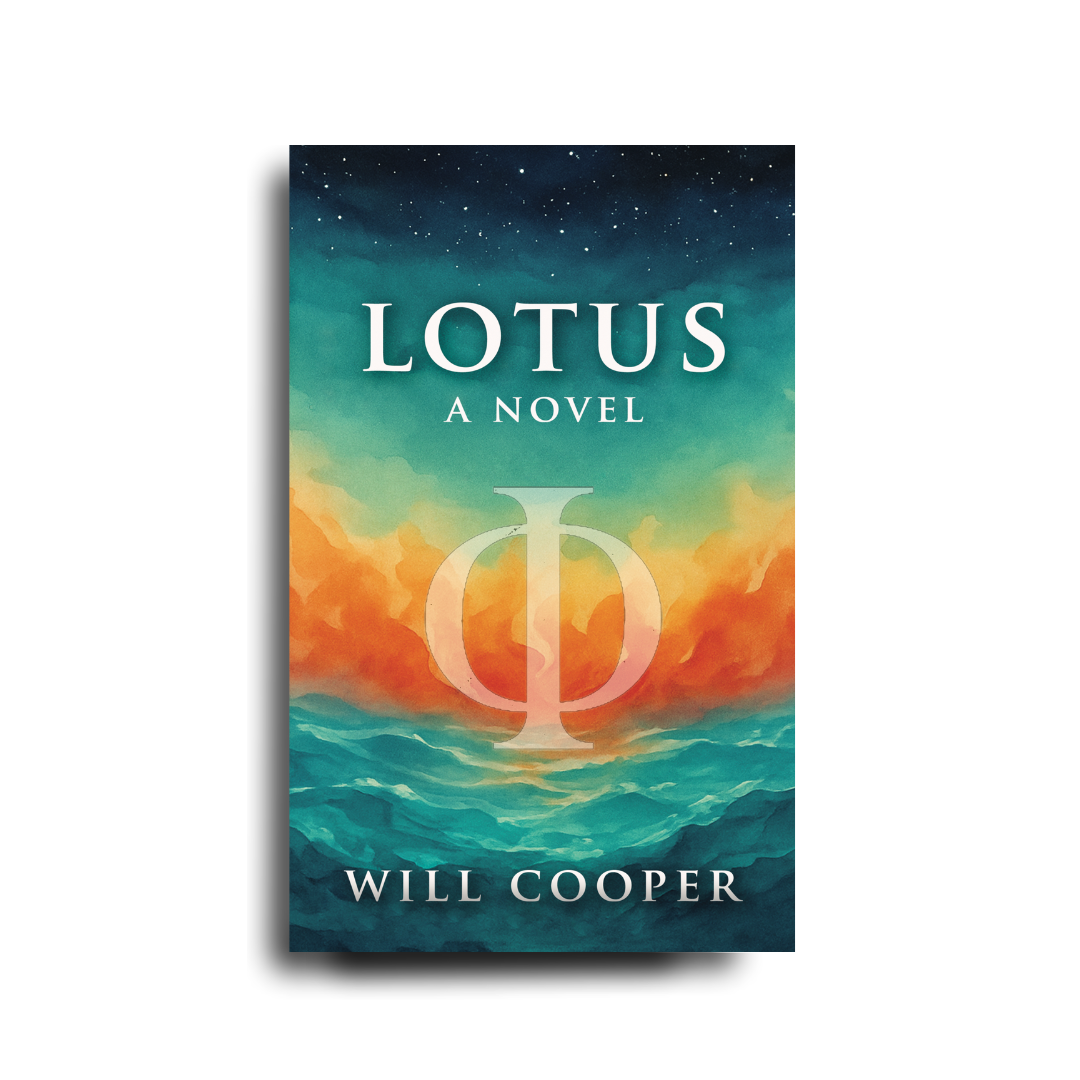
Will Cooper (An Author Spotlight Interview - April 2026)
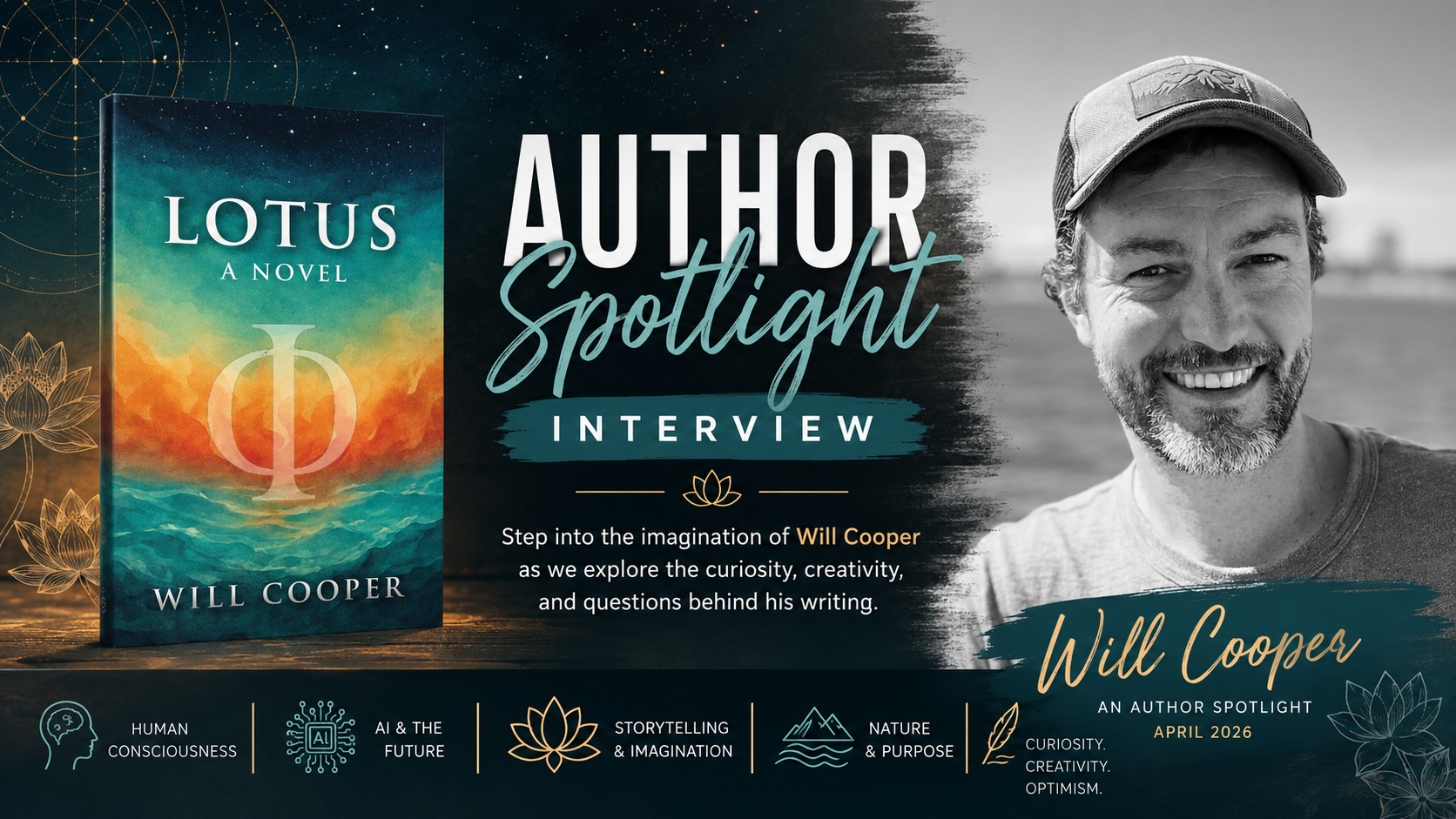
For more than twenty-five years, storytelling has been a quiet constant in Will Cooper’s life, shaped by curiosity, creativity, and a fascination with the stories we tell ourselves about who we are and where we might be headed. From a childhood spent wandering the woods and disappearing into books to early mornings devoted to writing before the rest of the household wakes, Cooper’s creative journey has always been rooted in observation and imagination. Now, as the author of Lotus and the mind behind The Lotus Trilogy, he is turning that curiosity toward some of the defining questions of our time: freedom, knowledge, consciousness, and our rapidly evolving relationship with artificial intelligence.
Living in rural Nova Scotia with his wife and three children, where they run a small farm animal sanctuary, Cooper has built a creative life that moves between writing, visual art, family, and the rhythms of the natural world. Influenced by the psychological depth and precision of writers such as Ian McEwan, Vladimir Nabokov, and J. M. Coetzee, his approach to storytelling is thoughtful and searching while remaining grounded in optimism. At the heart of his work is a belief that stories can do more than reflect the world around us. They can challenge the narratives we take for granted, expand what we believe is possible, and perhaps even help us imagine a better future.
In this exclusive Author Spotlight, Will opens up about the childhood experiences that first drew him to storytelling, the early-morning routine behind his creative process, and why some of his best ideas arrive while walking. He also reflects on finding an authentic voice, embracing doubt as part of the writing process, the importance of emotional vulnerability, and the questions surrounding human consciousness and AI that continue to shape The Lotus Trilogy. It’s a thoughtful conversation about creativity, curiosity, and what it means to keep writing in a world that is changing faster than ever.
Step into the imagination of Will Cooper as we explore the curiosity, creativity, and questions behind his writing, uncovering how storytelling, human consciousness, emerging technology, and an enduring sense of optimism come together to shape stories that challenge the way we see ourselves and the future we’re creating.
1. Can you tell us a bit about yourself and your journey as a writer?
I live in rural Nova Scotia with my wife and our three kids, where we run a small farm animal sanctuary and I work as an artist and writer. Writing has been a constant in my life for over 25 years, but it’s only recently that I committed to it—first completing a postgraduate diploma in creative writing and then finishing my first novel.
2. What inspired you to start writing, and how did you discover your passion for storytelling?
As a kid, I was very shy. My family moved around a lot, which didn’t help. I spent a lot of time in the woods and a lot of time reading. Reading taught me the power of stories, and it made me want to tell my own.
3. Could you share some insights into your creative process? Do you have any rituals or habits that help you write?
When I’m writing a first draft, I wake up very early in the morning to get a few hours of writing in before anyone else is awake. The story then percolates in my head for the rest of the day while I’m making art, working on the farm or going for a walk. Most of my best ideas come to me on walks.
4. What themes or messages do you often explore in your writing, and why are they important to you?
My writing often explores the limits of freedom and knowledge. Recently I’ve become interested in our evolving relationship with technology and its implications for the future.
Whatever I write, I’m an optimist—both by nature and by choice. Stories don’t just reflect reality—they help to create it by reimagining what’s possible. Right now we’re surrounded by narratives of fear. I want my work to push in the opposite direction—to make people think and feel, but also to open up the possibility of a better future.
There’s a great quote by Muriel Rukeyser: The universe is made of stories, not atoms. I’m less interested in what’s objectively true than in which stories help us live better and see more clearly.
5. Are there any particular authors or books that have influenced your writing style or storytelling approach?
I’ve been influenced by Ian McEwan, Vladimir Nabokov, and J. M. Coetzee—writers who combine psychological depth with precision and restraint.
The book that most shaped my worldview is Sapiens by Yuval Noah Harari, which frames history as a conflict between shared stories.
6. Do you have any advice for aspiring writers who are just starting their journey?
Just finish something. Dream it up, write an outline, then push through to the end. Forget about perfection. You’ll learn more from finishing one imperfect project than from endlessly refining an idea in your head. And don’t try to sound like a writer. Just try to sound like yourself. Each of us has an authentic voice that naturally emerges when we let it.
7. How do you balance writing with other aspects of your life, such as work, family, and personal interests?
It can be a challenge. For a long time I resented the commitments that pulled me away from writing. But eventually I came to accept this is just what my life looks like, and that the writing has to grow within it.
8. How do you stay motivated and overcome writer's block when faced with challenges in your writing process?
I think writer’s block is usually an indication I’m trying to force something that isn’t working. When that happens, I just need to step back, go for a walk, do something else that needs doing, or I write something else. If I force it, I’ll make it worse.
9. How do you manage your time and set goals to ensure consistent progress in your writing projects?
I’m not super rigid with goals, but when inspiration is flowing, I listen to it. George Orwell once described writing a book as being helplessly driven by a demon you don’t fully understand. That resonates with me a bit.
10. How do you handle moments of doubt or uncertainty in your writing process, and what strategies do you use to persevere through challenges?
I think doubt is part of the process. It’s probably counterproductive to fight against it. Sometimes doubt tells me when something is wrong. Or it might tell me I’m pushing too hard and I need to step back. Doubt can be paralyzing, but I think it becomes more of a guide as you learn to trust the process.
11. What role do emotions and empathy play in your writing, and how do you strive to evoke emotional responses from your readers?
My old writing prof used to say the only way to make readers feel something is to be emotionally vulnerable as a writer. This is something I’ve gotten better at through practice—and I guess also through getting to know myself better. Writing is a kind of feedback loop in that way: the more honest you are, the more you discover about yourself, the more honest you can be, and the better you can connect.
12. Can you share any insights into the importance of a strong opening hook or first chapter in capturing readers' attention and setting the tone for the rest of the book?
The opening is where you make a promise to the reader. It needs to create curiosity and a sense that the author knows their world. This is especially important for new writers. Established writers can rely on their audience, but new writers have to earn that attention from the first page. You have to make readers believe you know where you’re taking them, and make them want to follow you on the journey.
13. Can you discuss any experiences of writer's block or creative burnout, and how do you rejuvenate your creativity during those times?
Since writing isn’t my full-time job, I have the flexibility to step away when I lose momentum, so I’ve managed to avoid burnout so far.
14. Are there any upcoming projects or future plans that you're excited to share with your readers?
I’m currently working on the next book in The Lotus Trilogy, which continues to explore the relationship between human consciousness and AI.
Alongside that, I’m revisiting a memoir project that I started 25 years ago. It’s a very different kind of story, but it explores some of the same underlying questions—just from a much more personal place.
Books By Will Cooper